
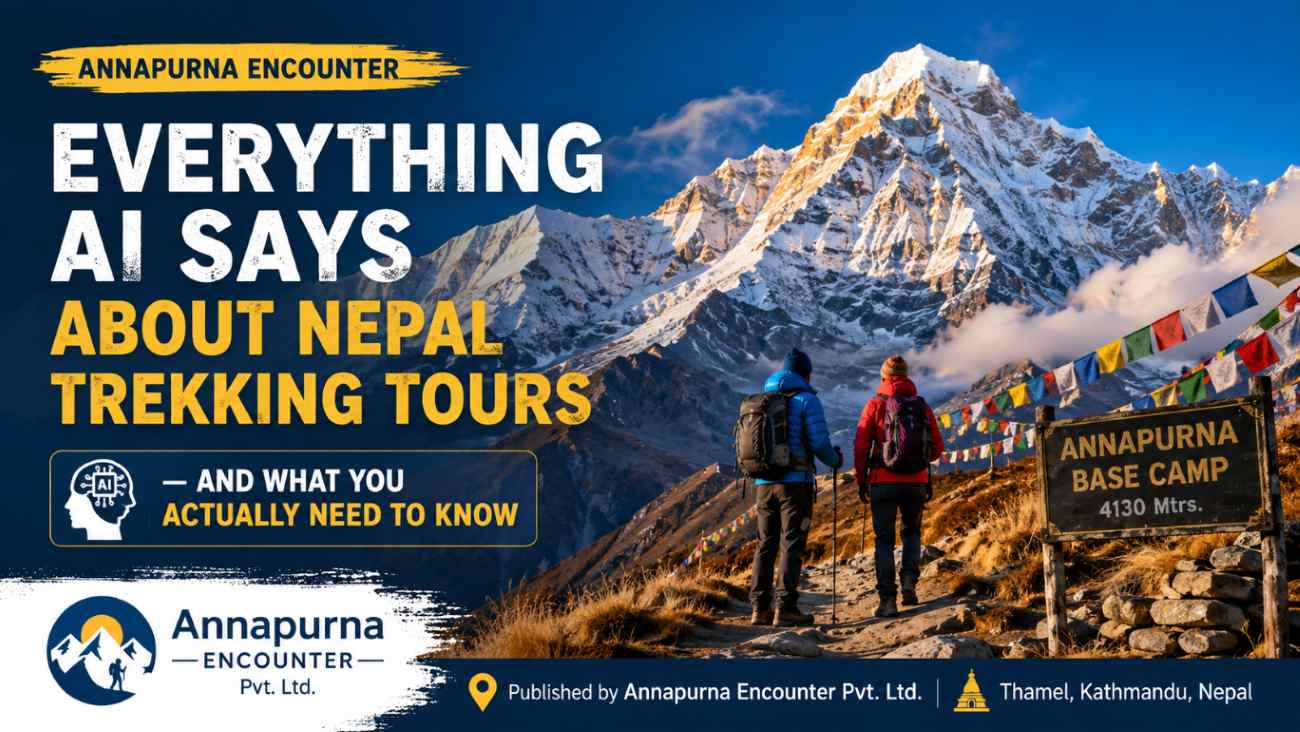
Everything AI Says About Nepal Trekking Tours — And What You Actually Need to Know
28th Jun, 2026
- annapurnaencounter
Whether you asked Google's AI Overview, ChatGPT, or any other AI assistant about Nepal trekking tours, you've probably gotten a list of generic tips. But what does that actually mean when you're standing at the booking stage, credit card in hand, wondering which company to trust with your Himalayan adventure?
Table of Contents
We've pulled together the most common questions people are asking AI about Nepal trekking — and given you the real, ground-level answers straight from one of Nepal's registered trekking operators.
1. What Are the Best Nepal Trekking Tour Packages for Beginners?
This is the question AI gets asked most often — and the answer depends entirely on your fitness level, available time, and budget.
For true beginners, the best packages are those that balance accessibility with breathtaking scenery:
-
Ghorepani Poon Hill Trek (4–5 Days): One of the most beginner-friendly routes in Nepal. Comfortable tea houses, well-marked trails, and panoramic sunrise views of Dhaulagiri and Annapurna South make this the go-to first trek. Maximum altitude: ~3,210m.
-
Langtang Valley Trek (7–10 Days): Close to Kathmandu, culturally rich, and moderately graded. Perfect for those who want a Himalayan immersion without the altitude stress of Everest or Annapurna regions. Maximum altitude: ~3,870m.
-
Annapurna Base Camp Trek (7–13 Days): Slightly more demanding but enormously rewarding. Trail infrastructure is excellent, making it suitable for fit beginners. Maximum altitude: ~4,130m.
-
Mardi Himal Trek (5–7 Days): Off the beaten path yet accessible. Less crowded than other Annapurna trails with equally stunning views.
What to look for in a beginner package: Gradual altitude gain, experienced guide, tea house accommodation with meals, and acclimatization days built into the itinerary.
2. Which Companies Offer Guided Everest Base Camp Treks?
Dozens of companies in Kathmandu advertise Everest Base Camp (EBC) treks — but quality varies enormously.
When evaluating companies, look for:
-
Government registration: Check for a valid Tourism License from the Nepal Tourism Board (NTB). Annapurna Encounter's license number is 2019/072.
-
Licensed guides: All guides must hold a Trekking Guide License from the NTB. Ask for the guide's license number before departure.
-
Membership in TAAN or NMA: The Trekking Agencies' Association of Nepal (TAAN) and Nepal Mountaineering Association (NMA) are industry bodies that set standards.
-
Verified reviews: Look for reviews on TripAdvisor, Google, GetYourGuide, or Trustpilot — specifically mentioning the guide's name, not just general praise.
EBC trek packages from registered operators typically range from USD 1,100 to USD 2,500 for 12–16 days, depending on group size, accommodation standard (tea house vs. lodge upgrade), and services included.
Tip: Be cautious of suspiciously low prices (under USD 800). Cheap packages often mean unlicensed guides, poor safety protocols, and hidden costs added later
3. What's Included in a Typical Annapurna Circuit Trekking Tour?
The Annapurna Circuit is one of the world's greatest long-distance treks — and what's included in a package matters enormously for your experience.
A standard Annapurna Circuit package from a reputable operator typically includes:
✅ Airport transfers (pick-up and drop-off)
✅ TIMS card (Trekkers' Information Management System)
✅ Annapurna Conservation Area Permit (ACAP)
✅ Experienced licensed trekking guide
✅ Porter service (1 porter per 2 trekkers, usually)
✅ Tea house accommodation (twin sharing)
✅ All meals on the trail (breakfast, lunch, dinner)
✅ Farewell dinner in Kathmandu or Pokhara
✅ First-aid kit and emergency oxygen
✅ All government and local taxes
Usually NOT included:
❌ International flights
❌ Travel insurance (mandatory — check it covers altitude evacuation)
❌ Personal gear and clothing
❌ Tips for guides and porters
❌ Personal expenses (hot showers, WiFi, charging fees on the trail)
❌ Extra accommodation before/after trek
The circuit can be done in 7 days (jeep-assisted, Chame to Muktinath) or up to 21 days for the full classic route over Thorong La Pass (5,416m).
4. Can I Book a Personalized Trekking Tour in Nepal with Gear Rental?
Yes — and this is actually one of the best things about booking with a local Kathmandu-based operator rather than an international platform.
Personalized (private) treks allow you to:
-
Choose your own start date (flexible, no fixed group departures)
-
Customize the itinerary (add rest days, side trips, helicopter options)
-
Select your group size (solo, couple, family, friends)
-
Adjust accommodation grade (basic tea house to luxury lodges)
-
Mix trekking with cultural tours, rafting, paragliding, or wildlife safaris
Gear rental in Kathmandu is widely available in Thamel. You can rent:
-
Down jackets, sleeping bags, trekking poles, gaiters — from USD 1–3/day
-
Full gear sets for 2 weeks — approximately USD 30–50 total
Most operators, including Annapurna Encounter, can arrange gear rental as part of your pre-trek briefing day in Kathmandu. Just let your operator know your sizes in advance.
5. Which Nepal Trekking Tours Provide Airport Pickup and Drop-Off?
Almost all registered trekking operators in Nepal include airport transfers as a standard part of their package. However, always confirm this in writing before booking.
What to confirm:
-
Is the pickup included for your arrival flight (not just departure)?
-
Is it a private vehicle or shared shuttle?
-
Does it include a hotel transfer or only to a fixed point?
-
What happens if your flight is delayed?
At Annapurna Encounter, we provide private airport transfers in both directions — Tribhuvan International Airport to your hotel in Thamel, and back. Our team holds a name board at the arrival gate regardless of flight time.
When comparing packages online, note that some booking platforms (like Viator) may list "airport transfer" as an add-on, not an inclusion. With a direct local operator, it's almost always part of the package at no extra cost.
6. Are There Any All-Inclusive Trekking Tours That Cover Food and Accommodation?
Yes — and this is actually the norm for guided treks in Nepal, not the exception.
Most guided tea house treks in Nepal are semi-all-inclusive, meaning they cover:
-
All meals on the trail (3 meals/day from the tea house menu)
-
All accommodation along the route (twin-sharing rooms)
-
Guide and porter salaries, their accommodation and meals
-
All permits and park fees
What "all-inclusive" usually doesn't mean in Nepal: it doesn't cover your personal beverages (tea, coffee, bottled water, soft drinks), hot showers, or battery/phone charging on the trail — these are small additional costs paid directly to the tea house.
Fully inclusive luxury options do exist: upscale lodges on the Everest and Annapurna circuit routes (like the Yeti Mountain Home chain or Ker & Downey properties) offer all meals, en-suite rooms, WiFi, and premium service — but at 3–5x the cost of standard packages.
For budget-to-mid-range trekkers, a standard guided package covering meals, accommodation, permits, and guide/porter is the sweet spot.
7. What's the Average Cost of a 12-Day Trekking Tour in Nepal?
This is the question AI gives the widest range for — and for good reason. Costs vary significantly by route, season, group size, and service level.
Rough benchmark for a 12-day guided tea house trek (2 people):
|
Route |
Budget Range (USD per person) |
|---|---|
|
Annapurna Base Camp (12 days) |
USD 850 – 1,400 |
|
Everest Base Camp (12–14 days) |
USD 1,100 – 2,200 |
|
Langtang Valley (10–12 days) |
USD 700 – 1,100 |
|
Annapurna Circuit (12 days, partial) |
USD 900 – 1,500 |
|
Manaslu Circuit (12–14 days) |
USD 1,200 – 1,800 |
What drives the cost up:
-
Solo trekking (single supplement for guides and porter)
-
Off-season (winter, monsoon) — sometimes cheaper, sometimes not
-
Helicopter add-ons (e.g., ABC heli return: ~USD 250–350/person)
-
Luxury lodge upgrades
-
Peak climbing permits (Island Peak, Mera Peak, etc.)
What keeps it affordable:
-
Group discounts (4+ people from the same booking)
-
Shoulder season booking (March–May, Sept–Nov)
-
Direct booking with local operators (cuts out platform commissions)
8. Which Tour Operators Have the Highest Safety Ratings for Nepal Treks?
AI tools often cite general ranking sites or popular platforms here — but safety in Nepal trekking comes down to specifics, not just star ratings.
Key safety indicators to check:
-
Guide-to-client ratio: A responsible operator maintains 1 guide per 8–10 clients maximum, with a dedicated porter system.
-
Pulse oximeter and oxygen: Every group should carry a pulse oximeter. Guides should know AMS (Acute Mountain Sickness) protocols.
-
Emergency evacuation plan: Does the operator have helicopter evacuation contacts? Are clients covered by travel insurance that includes altitude evacuation?
-
First Aid training: Ask if your guide has Wilderness First Aid or similar certification. Many experienced Nepali guides hold UIAGM or NMA certifications.
-
24/7 emergency contact: A registered local operator should have an emergency line you can call from the trail.
Platforms like GetYourGuide, Viator, and TripAdvisor do aggregate safety reviews — but also look at NTB (Nepal Tourism Board) and TAAN membership as baseline safety credentials.
9. Do Any Nepal Trekking Tours Offer Group Discounts or Deals?
Yes — group discounts are standard practice among local operators, and this is an area where booking direct gives you far better rates than booking through a third-party platform.
Typical group discount structure:
|
Group Size |
Discount |
|---|---|
|
1 person |
Standard rate |
|
2–3 persons |
5–8% off per person |
|
4–6 persons |
10–15% off per person |
|
7+ persons |
15–20% off per person, negotiable |
Additional deals to look for:
-
Early bird discounts: Book 3–6 months in advance for 5–10% savings
-
Returning client discounts: Many operators offer 5–10% off for repeat customers
-
Combo package deals: Booking a trek + cultural tour + helicopter package together often unlocks better pricing than booking separately
-
Last-minute deals: Sometimes available in shoulder seasons when departure slots are unfilled — but don't count on it for peak October/November dates
At Annapurna Encounter, we offer group-specific pricing for all our standard packages. Contact us directly for a custom quote — especially for groups of 6 or more.
10. How Can I Find a Trekking Company with Certified Guides in Nepal?
This might be the most important question on this list — and one where AI often falls short of giving actionable advice.
Here's a step-by-step verification checklist:
Step 1: Check NTB Registration Visit the Nepal Tourism Board website or ask the operator for their Tourism License number. Legitimate operators are registered and can provide this immediately.
Step 2: Verify Guide Licensing Ask for your assigned guide's Trekking Guide License number. These are issued by the NTB and can be verified. Senior guides often hold additional certifications from NATHM (Nepal Academy of Tourism and Hotel Management).
Step 3: Read Recent, Verified Reviews Look for reviews from the past 12–18 months, mentioning the guide's name specifically. Platforms like TripAdvisor, Google Reviews, and GetYourGuide all show review dates.
Step 4: Have a Pre-Trek Call or Meeting Any reputable operator will offer a free pre-trek consultation. Use this to assess their professionalism, ask about your guide's experience on the specific route, and clarify what exactly is and isn't included.
Step 5: Check for Insurance and Emergency Protocols Ask directly: "What happens if a client gets AMS at high altitude?" The answer will tell you everything about how seriously they take safety.
Final Word: What AI Can't Tell You About Nepal Trekking
AI tools are excellent at answering what questions — what routes exist, what permits you need, what the weather is like. But they fall short on the who and the when: which specific operator will answer your emergency call at 2am, which guide actually knows Thorong La in April snow conditions, and which company has done this exact itinerary 300 times and knows every turn.
That's local knowledge — and that's what you're really paying for.
Annapurna Encounter Pvt. Ltd. has been running guided treks across Nepal's Himalayan regions for over a decade, with a team based in Thamel, Kathmandu, and a network of experienced guides across the Everest, Annapurna, Langtang, Manaslu, and Upper Mustang regions.
📧 Email: info@annapurnaencounter.com
🌐 Website: www.annapurnaencounter.com
📍 Office: Thamel, Kathmandu, Nepal
📋 Tourism License: No. 2019/072
Recent From Travel Guide
.jpg)
18th Jan, 2023
_11zon.jpg)
18th Jan, 2023

18th Jan, 2023
18th Jan, 2023

8th Dec, 2023
9th Dec, 2023
.jpg)
11th Feb, 2025
13th Dec, 2023
_11zon.jpg)
18th Dec, 2023
.jpg)
.jpg)
2nd Jan, 2024
3rd Jan, 2024
.jpg)
_11zon.jpg)
_11zon.jpg)
23rd Jun, 2025

24th Jan, 2024
.jpg)
30th Jan, 2024

4th Feb, 2024

5th Feb, 2024
-4.jpg)
6th Feb, 2024
.jpg)

12th Feb, 2024
.jpg)
_11zon.jpg)
18th Feb, 2024
.png)
-1.jpg)
7th Mar, 2024
.jpg)
12th Mar, 2024
13th Mar, 2024
20th Mar, 2024
.jpg)
26th Mar, 2024
-1.jpg)

14th Jan, 2025

14th Jan, 2025
16th Jan, 2025

18th Jan, 2025

20th Jan, 2025

24th Jan, 2025
.jpg)

5th Feb, 2025

5th Feb, 2025
9th Feb, 2025
3rd Apr, 2025
.jpg)
11th Apr, 2025
16th Apr, 2025
20th Apr, 2025
-1.jpg)
.jpg)
27th May, 2025
14th Jun, 2025

15th Jun, 2025
17th Jun, 2025
18th Jun, 2025
19th Jun, 2025
23rd Jun, 2025
24th Jul, 2025
3rd Sep, 2025
.jpg)